Birthday wishes

These days, the bar is very low. You can quickly congratulate someone on their birthday in one of the countless chat groups you belong to, write a short sentence without any real meaning, and you’re done. You’ve “done your part,” but no one really pays close attention. It’s just more digital noise, digital pollution, and wasted time.

I still remember calling someone on a landline for their birthday—full of intention and presence.

Even when someone writes a deep, personal note, you need to be in a particular state of awareness to truly appreciate it.

I don’t share these empty wishes, and I don’t want to receive them either. That probably makes me seem like a weirdo.

Many years ago, I chose a few people with whom I exchange personal wishes. I chose them because something in their energy resonated with me. They are the select few who lift my energy rather than drag me down or waste my time with shallow, meaningless one-sentence messages.

And this has continued for years—beautiful and almost effortless.

Goodbye to Fact-Based Reality Analysis – Part One

I don’t know if it ever existed and is now gone. It’s possible that the very reasons I attribute to its disappearance are actually just the messenger exposing the fact that it never existed at all.

​We humans change with age. Some become more certain of things, while others grow more aware of life’s complexities. Maybe all the following analysis is just me getting older. Maybe there’s more to it.

Paradoxically, the Information Age has made us blind to information. We have too much of it, and we are presented with information curated by algorithms—black boxes developed to maximize engagement and, perhaps, to create global chaos, although this last point is hard to prove.

Reality communicates with history, and human weaknesses do not change. The logical conclusion is to study the past. But if we know reality is portrayed by people and machines with agendas, who can guarantee our understanding of the past is accurate?

From a historical perspective, the most relevant human weaknesses are fear, greed, and ego. These are constant. The new addition that technology amplifies is the human tendency for addiction. In the past, one could abuse an addiction with alcohol, cards, food, etc. The impact of these was confined to one’s immediate environment. These days, with mobile devices, the internet, and social networks, human addiction is impacting a much wider environment. The toxic effects are spreading across nations and beyond.

Economically, inequality is deepening, or at least it is much more visible and discussed. It’s the starting point of any populist movement. Today, a non-populist leader can only compete by adopting a populist toolkit. All of this drives more negativity, misinformation, and divisiveness.

​World powers are engaged in a new cold war, trade war, and social media campaigns to weaken other countries, encourage immigration, and promote drug consumption, all while taking advantage of modern democracies’ weaknesses.

Blockchain and AI are amazing innovations, but they are also being adopted by countries and money-laundering organizations.

​Going back to history, go and find a century in which Western countries did not engage in wars. There are none, at least not in the last few hundred years. Why should that change, especially in light of the above?

Go listen to Dominic Sandbrook and get a wakeup call.

​Individuals and countries tend to react slowly to the fast changes that technology brings us. Many aren’t even grasping it.

​Do you agree? If so, what can be done? More next week.

Happy?

you aren’t happy now. Maybe you want something to be different, or that you wish a problem or a friction will disappear. You feel it in your body, in your stomach or chest, in your eyes. Energy is low, doing feels heavy on you.

You look back, years, decades – trying to recall a time it was different, it felt different.

You don’t remember, maybe there was a time but memory is vague.

One memory pops – winter, a late weekend night, alone in bed. Probably rain outside. It’s warm inside your blanket. Listening to the radio, a show with good music, that fits a cold winter night. It feels the radio person is talking directly to you. You are not tired, you don’t feel FOMO. You want it to continue forever. You were happy.

If you could choose

If you could choose, would you prefer to be able to enjoy to the fullest being quiet and still, or active and energetic?

If you could choose, would you prefer to be exactly as you are, or the opposite?

If you could choose, what would you change?

Can we choose? Should we?

I know I can’t, but I wish I could.

Making peace with this notion is energy consuming.

Search for what energizes you. Search for what brings you peace. Search for what makes you happy.

///***\\\

“It is not the neurotic’s self-concern, whether pity or contempt, which breaks the circle formation; the cue to cure is self-transcendence!” Viktor Frankl

Comparing S&P sectors – long term view

On another occasion I’ll share the main views on why shares, why long term, why buy and hold etc. I kind of feel everybody already knows it. In any case, If you want to hold shares for the long run you need a way to understand what’s the upside, downside and how the ride is going to feel if it goes wrong, as it sometimes happen. In other words:

  1. Returns
  2. Risk Adjusted Returns
  3. Downside and risk
  4. Trend

I have many interesting comparisons of different alternatives for the long run. Here is a sample comparison of several sectors.

And for the risk adjusted aspect (using a 2% annual risk free interest just for the sake of example):

Now this is of course not a recommendation for investing, you should really do your homework or discuss someone. It is however an interesting way to compare, and to kick off your analysis.

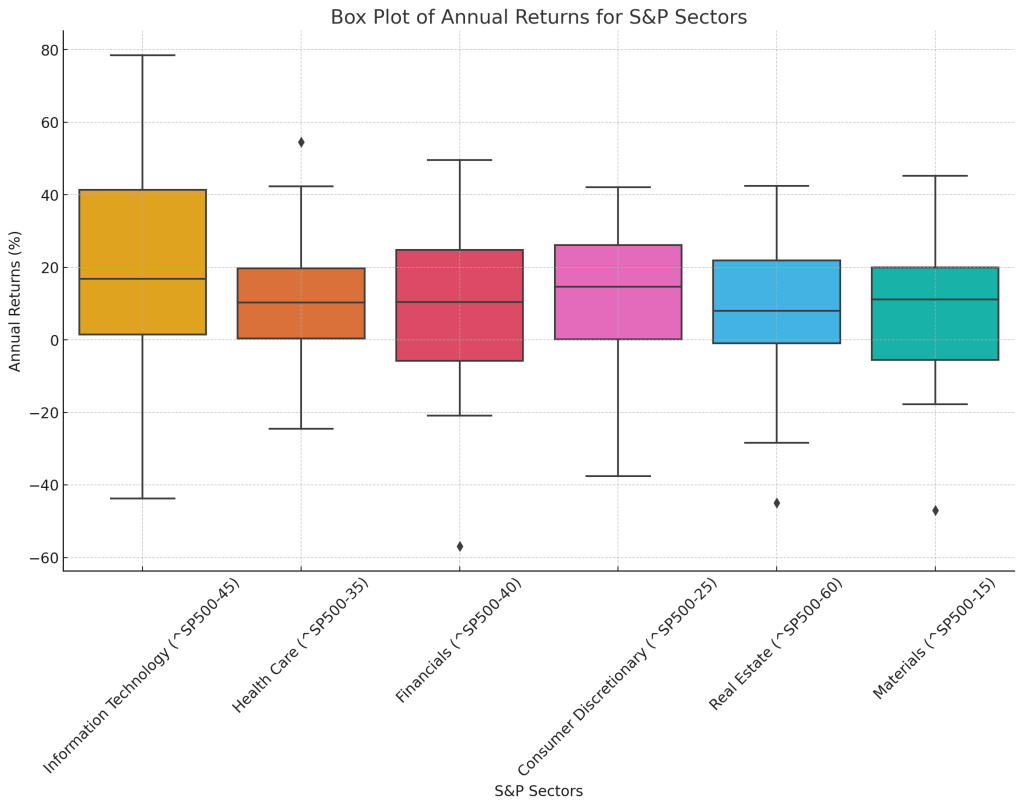
For the boxplot fans out there (is that a thing? i really like them), It tells the same story, easy to see the two on the left. Do note the outliers, the one on the financial sector is a big one. For the tech high of 1999 or financial high of 2007, it went down and took more than 10 years for each sector to recoup the loss, but that’s an edge case where you bought on the highest high. If you don’t try to time the market and don’t sell when it’s hard, you should do fine.

Disclaimer: The information provided in this blog is for educational and informational purposes only. It is not intended as investment advice or a recommendation to buy or sell any financial instruments. Please conduct your own research and consult with a financial advisor before making any investment decisions.