Our kids, our world

The moment they do things you’ve never done or could have done, you look at them, amazed, a life coming from you. Such magic, such an incredible moment, yet so easy to take for granted. You created something better than yourself.

When they fail, it hurts so much, far more than when you fail. The pain can be so deep that you sometimes need to be alone, to hold it and sit with it until it moves on. You want the world to be kind to them, but the world is a tough place. You can’t know the future or guarantee anything. For yourself, that was never a big issue, but it’s a heavy feeling when you think and pray for their future.

Our kids. Our world.

Goodbye to Fact-Based Reality Analysis – Part One

I don’t know if it ever existed and is now gone. It’s possible that the very reasons I attribute to its disappearance are actually just the messenger exposing the fact that it never existed at all.

​We humans change with age. Some become more certain of things, while others grow more aware of life’s complexities. Maybe all the following analysis is just me getting older. Maybe there’s more to it.

Paradoxically, the Information Age has made us blind to information. We have too much of it, and we are presented with information curated by algorithms—black boxes developed to maximize engagement and, perhaps, to create global chaos, although this last point is hard to prove.

Reality communicates with history, and human weaknesses do not change. The logical conclusion is to study the past. But if we know reality is portrayed by people and machines with agendas, who can guarantee our understanding of the past is accurate?

From a historical perspective, the most relevant human weaknesses are fear, greed, and ego. These are constant. The new addition that technology amplifies is the human tendency for addiction. In the past, one could abuse an addiction with alcohol, cards, food, etc. The impact of these was confined to one’s immediate environment. These days, with mobile devices, the internet, and social networks, human addiction is impacting a much wider environment. The toxic effects are spreading across nations and beyond.

Economically, inequality is deepening, or at least it is much more visible and discussed. It’s the starting point of any populist movement. Today, a non-populist leader can only compete by adopting a populist toolkit. All of this drives more negativity, misinformation, and divisiveness.

​World powers are engaged in a new cold war, trade war, and social media campaigns to weaken other countries, encourage immigration, and promote drug consumption, all while taking advantage of modern democracies’ weaknesses.

Blockchain and AI are amazing innovations, but they are also being adopted by countries and money-laundering organizations.

​Going back to history, go and find a century in which Western countries did not engage in wars. There are none, at least not in the last few hundred years. Why should that change, especially in light of the above?

Go listen to Dominic Sandbrook and get a wakeup call.

​Individuals and countries tend to react slowly to the fast changes that technology brings us. Many aren’t even grasping it.

​Do you agree? If so, what can be done? More next week.

Comparing S&P sectors – long term view

On another occasion I’ll share the main views on why shares, why long term, why buy and hold etc. I kind of feel everybody already knows it. In any case, If you want to hold shares for the long run you need a way to understand what’s the upside, downside and how the ride is going to feel if it goes wrong, as it sometimes happen. In other words:

  1. Returns
  2. Risk Adjusted Returns
  3. Downside and risk
  4. Trend

I have many interesting comparisons of different alternatives for the long run. Here is a sample comparison of several sectors.

And for the risk adjusted aspect (using a 2% annual risk free interest just for the sake of example):

Now this is of course not a recommendation for investing, you should really do your homework or discuss someone. It is however an interesting way to compare, and to kick off your analysis.

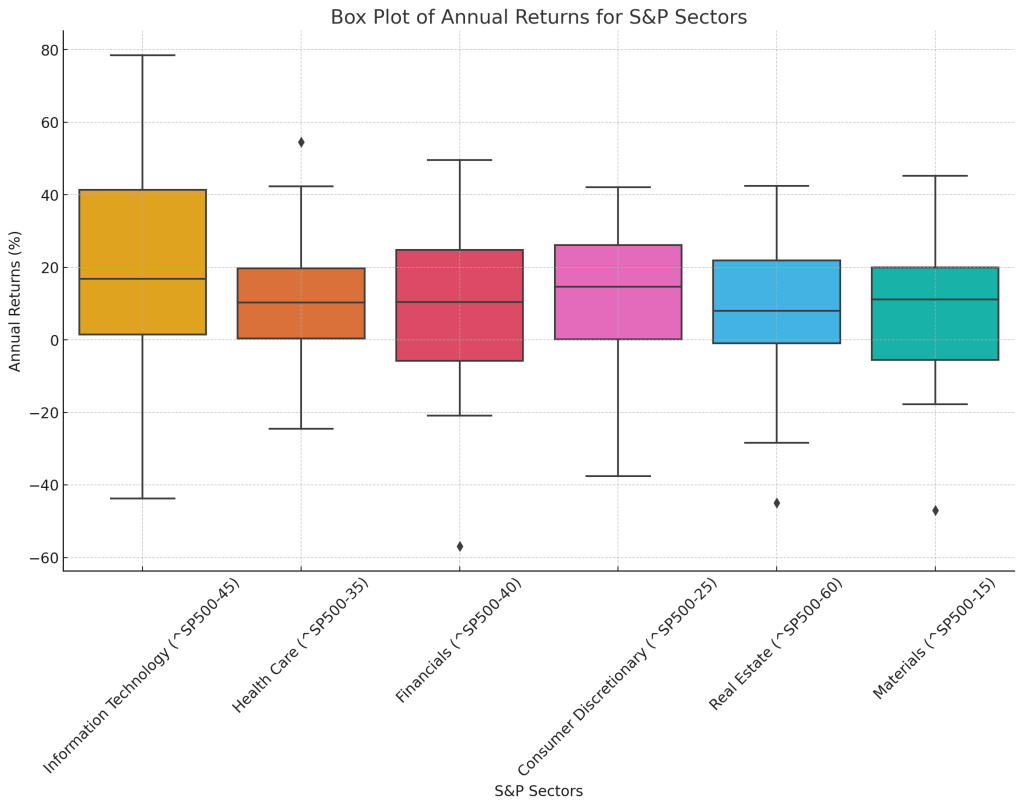
For the boxplot fans out there (is that a thing? i really like them), It tells the same story, easy to see the two on the left. Do note the outliers, the one on the financial sector is a big one. For the tech high of 1999 or financial high of 2007, it went down and took more than 10 years for each sector to recoup the loss, but that’s an edge case where you bought on the highest high. If you don’t try to time the market and don’t sell when it’s hard, you should do fine.

Disclaimer: The information provided in this blog is for educational and informational purposes only. It is not intended as investment advice or a recommendation to buy or sell any financial instruments. Please conduct your own research and consult with a financial advisor before making any investment decisions.

Good friends

How do you know it’s deep? When you meet each other after a long time, it feels as if you saw each other yesterday. It feels like routine, with a little warmth inside. You know the good and the bad. It’s predictable but holds interesting updates.

Why it’s deep? because you’ve been to a lot together. Many times you didn’t choose each other, someone else did it for you, but the result is shared values, memories and experiences. Good times and many bad times. Everyone is an open book. No one tries to hide anything. No one can or wants to hide something.

When meeting a group of people with deep connection, there’s a special energy for that. People around this group can also feel it. The trust is high, the laughs are contagious.

You might feel tired after these meetings, but on a deeper level, it fills your battery. It strengthen the core that support your long term energy, not the daily one.

It’s valuable because there are no shortcuts. It’s deep because it’s deep. If it’s shallow, it will never be deep.